

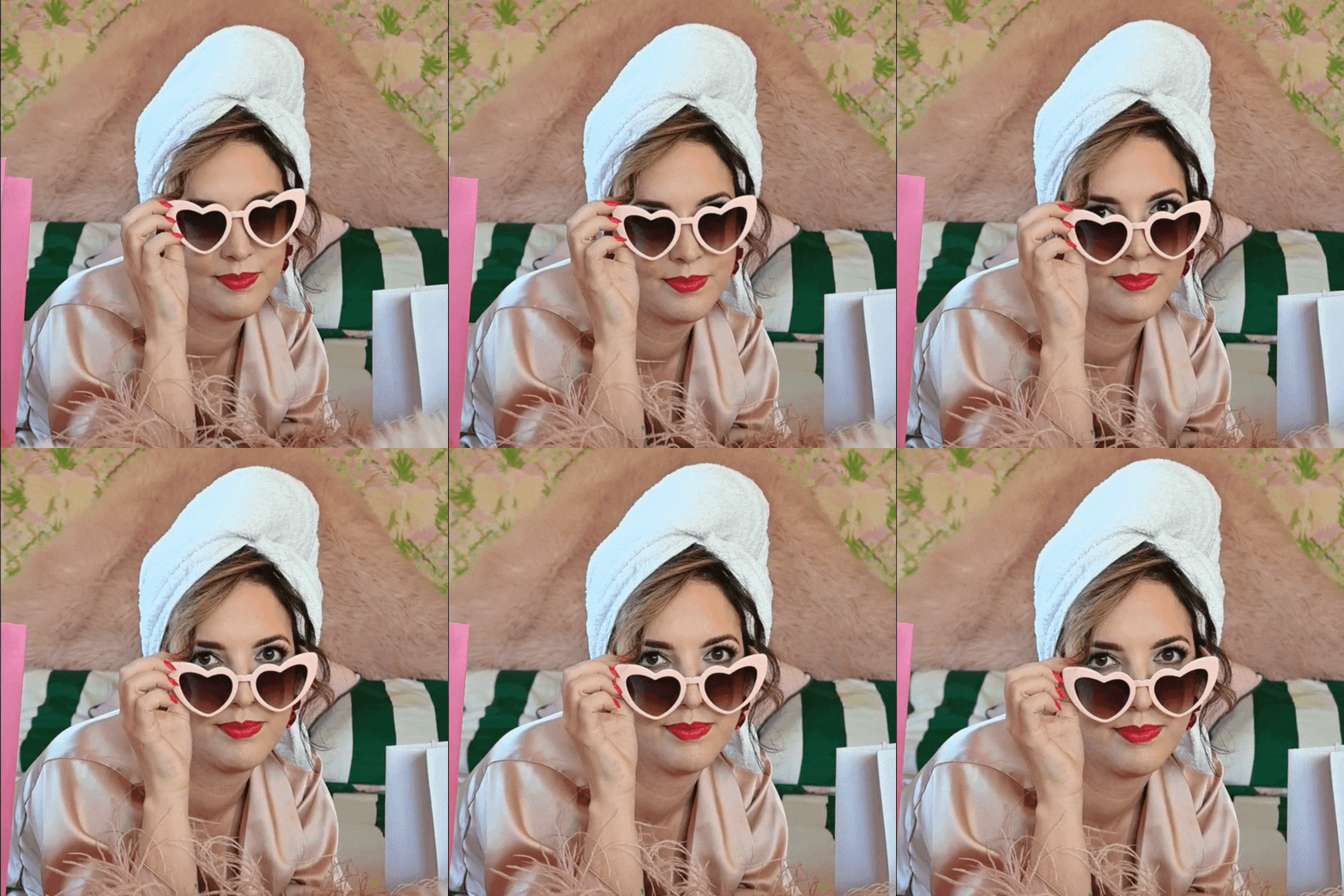












I was genuinely excited to record this one because money isn’t just numbers, it’s identity, safety and nervous system stuff we’re rarely taught to look at.
In this conversation with Cleo Nedd, we talk about why so many women can make money but feel strangely uncomfortable holding onto it, and how that links back to money trauma, family patterns and being one of the first generations really building wealth on our own terms.
Cleo helps high achieving women stop endlessly earning and start building real wealth. She’s a financial coach and money trauma specialist who blends money psychology with practical wealth strategy, so your money actually starts working harder for you.
We talk about paying yourself without guilt, investing as a habit rather than a personality type, and building financial confidence when you’re self-employed and cash flow isn’t always predictable. This episode is grounding, expansive and quietly powerful.
Tune into the episode:
How to subscribe + review:
Be the first to know when new episodes are released.
Also, podcast reviews are important for the iTunes algorithm and the more reviews we receive, the more likely we’ll be able to get this podcast and message in front of more people. I’d be grateful if you left a review right here letting me know your favourite part of this episode.
As always, if it was helpful, please do share your questions and takeaways you’ve made by tagging @pollylavarello so I can repost you!
Thanks for your support.
Polly x
To find out more:
The Profitable Practitioner’s Free Guide
Cleo’s bio:
Cleo Nedd helps high-achieving women stop earning and start building real wealth. As a Financial Coach and Money Trauma Specialist, she combines money psychology with wealth strategy to help women get their money working harder and build six- and seven-figure legacies.
She’s a former accountant, keynote speaker, host of The Money Couch, and has been featured in Women’s Health, Black Ballad and The Voice.
Cleo’s Links:
Women, Wealth & Why No One Taught Us This with Cleo Nedd – Episode Transcription
00:00
Welcome to Make More Money Without Selling Your Soul. The podcast for bold entrepreneurs ready to simplify scale and reclaim their time. I’m Polly Lavarello, Evergreen scaling strategist and cushy business pioneer. Join me and my occasional guests as we explore the themes of wealth, selling and well-being, because building a business that works for you changes everything. Let’s dive in.
00:37
Hello, my loves and welcome back to Make More Money Without Selling Your Soul, I am genuinely so excited about today’s conversation, because my guest is not only a brilliant brain and a brilliant heart, but she’s also a friend. We’re talking about money, but not in that dry spreadsheets only just cut back on the lattes kind of way. We’re talking about money as identity, money as safety, money as nervous system, and money as a legacy. Because if you’ve ever felt that you can make money, but holding on to it feels weirdly sticky, or like the moment you earn more, you somehow find new ways to spend more, give more, reinvest more, or just not. Let it land. This episode is for you. My guest today is Cleo Nedd, the founder of Women about Finance. Cleo is a financial coach and money trauma specialist, and she supports women to make smarter financial decisions so they can multiply their income and build real wealth, not just in business, but in life. She’s been featured in women’s health magazine, black ballad and the voice. She delivers financial wellbeing workshops for companies and educational institutions, and she owns her own podcast, the money couch. In this conversation, we talk about why so many women are effectively the first generation learning how to build wealth independently and why that matters. We talk about why paying yourself can feel so emotionally loaded. We talk about investing as a habit, not a personality type, and we talk about how to build financial confidence in a way that actually feels safe and aligned, especially when you’re self employed, and cash flow isn’t always straight line. Okay, grab a cuppa, take a breath, and let’s get into it. I am always so excited to have a guest on the show that is not only a brilliant brain, beautiful heart, but also a friend, and that is my wonderful guest today, Cleo. Cleo, would you like to introduce yourself to my listeners?
02:40
Thank you so much, Polly, thank you so much for having me really excited to have this episode with you today. I’m Cleo Nedd. I’m a financial coach and a money trauma specialist, and I’m all about wanting women to become unreasonably wealthy. Why? Because I feel like the world wouldn’t be so much the very short show as it is now, because the way that we actually are with money, and the way that we’re able to have the capacity to grow it and really do positive impact in the world, the world will be a better place. So the way that I contribute to that in the world is to support women to not only be able to have money and be able to hold it and feel safe, to be able to hold it, but be able to actually grow it their own personal wealth through their businesses. So they get to have another avenue, not just their businesses that are actually bringing in the money, but ways that they can actually diversify their income. So they get to slow down and not have the me to always exchange time for money, but actually invest in certain ways that you can actually be supported by money, rather than working smarter than harder. So then you get to do the things that you actually truly love because you want to, not because you need to slow down and just be able to have money supporting you in a way that allows you to really do the things that you know that is you’re here for to have a positive impact. And so mastering money and mastering wealth is so fundamental to be able to do that.
04:09
Yes, yeah, money is an interesting one, isn’t it, because people can have such mixed feelings around it. And I think one of the things that people really aren’t aware of is how, where, if you deem having money to be gross or vulgar or something you’re not deserving of, that that will inadvertently put up resistance to you being able to claim and own more money. And one of the things I’ve always loved about you Cleo is not only do you do the amazing, not only do you have these amazing solutions for like you say, how to have your money make more money, essentially, but also before that, helping people break through the resistance they may feel around money, the trauma they may have around money. And this might be the first time anyone’s thinking about the words trauma and money together. Would you be happy to expand on that a bit more?
04:59
Yeah, absolutely. Rightly so I’m going to do it really in context of women first, and especially the people that you really speak to as the wealth practitioners, the therapist. So as a woman, I want you to cut yourself some slack. Why it’s only been accessible for you to be able to actually have a bank account without a male guarantor for the last 50 years, and equally, to be able to invest. And it’s only been that’s 50 years that women have actually felt empowered and liberated to actually earn their own money and their own keep when you can put in context in terms of how long it’s been able to you’ve been able to invest. The stock market’s been around since the 1700s and yet women have only been able to have the capacity to actually invest in the last 50 years. So wild, isn’t it? It’s just mad. And what that means is that women are in this new generation. We are the new eras really, in regards to being able to unapologetically be wealthy. I’m not saying there hasn’t been women who have created legacies when it comes to wealth and build wealth in the past. I’m not saying that they’re such a minority. We are in the new era of the majority, where we have our own money and we’re able to actually multiply. We were to grow it ourselves without needing a man to be able to support us with that, because we have the tools like no other generation has been able to before. But it’s only been the last 50 years, and what we thrive on as women is community, is connection, is talking to one another and learning from each other about the trials and tribulations, the ebbs and the flows of whatever it is that we do, that that hasn’t been passed down to us, our nuns, our aunties, our mothers, they didn’t have those conversations with us. There’s wealth conversations around the table. Why? Because it just wasn’t accessible to them. So they didn’t have that knowledge, they didn’t have that wisdom to be able to pass down to us. So for us, we are technically the first second generation to be able to start having those wealth conversations about being women who earn, well, who are, you know, switching to the female breadwinners and the ones who want to make an unreasonable of wealth because we want to create our own legacies that are that requires us to have a hell of lots of money, and we haven’t had those conversations. So therefore, cut yourself some slack, because you are the first of your kind who are actually starting to create and build those wealth conversations and have those unapologetically with other women. You’ve raised so
07:36
many interesting points there, and one I’d really like to dial in on is not just what it means to kind of be a woman who’s making money and investing money and learning all those ways, but also right down to our childhoods. You know what we’ve observed in our parents, their thoughts and feelings around money? Now we learn as children what is safe through what our parents model and what they what we hear them saying around us. So there’s also a lot of subconscious bias we have. You know, either you know, one of the things I found so fascinating both having had an experience of being on benefits and equally, having had the experience of being around millionaires and people who own yachts and stuff, people use the word entitlement, but I think it’s really one of the things I found really fascinating about being around some of the Uber wealthy is that they just assume wealth is inevitable, that it is a non negotiable, and they design their lives around it. And even when the money isn’t coming, they’ll often just refer to it as, like, there’s a cash flow issue, there’s a problem that needs to be solved, never really making it mean something about them, necessarily. Now, that’s obviously a huge generalization, and of course, there’s all the kind of, you know, there’s the ugly side that comes with that, as well mass consumerism and and you know, where people do associate their identity with their wealth, which is, I mean, I guess I don’t know, that’s a whole interesting conversation right there, but, but then, equally, from the other end of the spectrum, I noticed that when I was on benefits and spending time with other people at the Job Center, how certain people would just kind of assume it was going To have to be hard that it would be difficult for their situation to change. And one thing I’ve always had to acknowledge about my situation is that I came with the privilege that I’d grown up with a middle class family so my normal, I was always aiming to get back to my normal, and that never seemed out of reach for me, because that is what I almost had a sense of entitlement to. And so I, you know, I think I looked at the world in a different way, and it allowed that to come to me more easily. And I think one of the things from that experience, you know, I mean, obviously society and the challenges is huge. And, I mean, I’m so disqualified to even talk about any of these things, but it’s certainly really. Highlighted to me on a very basic level, before we look at anything more complicated, the importance of money mindset, the importance of being open and happy to receive and not seeing money dirty, or not seeing money as something that only x people have, and allowing it to be mine. And interestingly, I often reflect that I’ve also reached the middle class stage, and I’ve stayed there as well, which I also think is slightly reflective of my own limiting beliefs around what I believe I’m entitled to. I mean, obviously that’s my little show about my experience. And as I say, I’m not an expert by any means, and I know there’s a whole much bigger societal, political stuff at play, but on a very personal level, that’s what played out for me. I’m curious to know what your thoughts and beliefs are around how we can without meaning to repel money or feel unsafe with money, and the kind of money habits we can get into that don’t necessarily support us even when we are, let’s say earning money.
11:05
I love that Polly, and I just want to also commend to you that even though you say that you come from a middle class background and that you that was your your normal set point, there’s also women that have, I have worked with, who have been middle, very upper middle class, but because it just wasn’t normal for women in their in their generations to have money, they still had that very broke poor mentality and didn’t believe themselves that they could actually earn what they saw, what was, what was deemed as their Normal surroundings, but actually doing it independently themselves. They still felt really afraid to be able to actually do that, because they didn’t have the example of their mother, their grandmother, aunties, whoever, females that were around them to able to actually acquire that type of wealth, because it was just wasn’t the dumb thing, even though they came from money, so to speak, but for them to do it themselves, that also was deemed as unsafe. So there’s also that I would like to bring to your attention, as well as, like the parts of what you were taught about money, is that it was, it doesn’t matter whether you’re male or female, to be able to actually acquire that type of money, acquired, acquire that type of wealth, where there’s actually some women who are, you know, very well off, who still feel that they couldn’t even, you know, rub two pennies together, even though they really want to, and that they have, they have done in terms of their careers and stuff like that, but they still have that mentality. They still have, they have the six figures, but still don’t feel like they could rip two pennies together, just because they just don’t feel safe to be holding that capacity of all that money and all that income, so that, I just want to also preface as well, that also shows up even if you do come from money, it all depends on what you as an individual and where you’ve come from. What is the belief system within your childhood of whether it is the right thing for you to be able to actually have your own independence when it
13:03
comes to money, that’s so interesting. There’s so many layers to it. Because yes, I was what I mean, my mum was one of the few main earners in the family. Like, you know, most my friends had dads who were the main earners, and some, very often actually mums who are stay at home mums or who had part time jobs. While I grew up watching my mum running her own design agency and going off to London and going off for girly weekends in Barcelona and coming back with design, funnily enough, feeling like she was poor, never feeling like she had enough money, and always doing that. Oh, I bought this in the sale. So there were also some kind of, you know, bits that came with that, but I guess in its own way, that created its own permission set for me that I also got to be successful. It’s amazing, isn’t it? I think, I think that’s one of the things that I feel excited about having you as a guest on the show today, is that I really hope that through people listening to this conversation today, no matter what they take from it, that they at least take a moment to sit with their relationship with money. You know, we often sit with our romantic relationships. We think about our relationship to work, and is it burning us out? But I don’t think enough of us are very conscious about our relationship with money, about our belief that we are deserving of it, or that we are safe holding it. I think I’ve shared with you one of the mistakes I made earlier on in my business, and one that I’m getting better at now, but probably still not as good as I can be, is holding on to money. I’m very good at making money, but I certainly early on in my business, felt the safest place for my money was reinvested in in the business. And I was really adamant I wanted to have team members who all paid, like, really good salaries and really, like, take care of everyone and everything in my world. Because I felt like those, you know, that was me. I mean, in many ways, I still stand by that. I think it’s really important to have, you know, a business that you. Feel great about, but I certainly recognize, when talking to a lot of other business owners, that they weren’t quite as enthusiastically reinvesting in their business as I was, and I’ve had to learn to be more protective of profit margins. Learn how to be more protective of even looking at something and going, yes, my business is paying for that, but that, instead of that being that that could be a long weekend with my kids, what’s more important is it really going to move the needle enough my business to justify that well before I used to see my money is one thing, and my salary that was paying myself, which was, you know, fine, good. And then my business money, which is separate, and it just had its own little life.
15:43
Yeah, yeah. And that’s so common, because even though your business may be successful and the bottom line or the top line, and the bottom line looks reasonably okay, one of the challenges is that even when you’re coming from the space of like, okay, I’ve come from humble beginnings or and I’ve been really successful, and I’ve been able to make, you know, this certain money, or I didn’t think someone like myself could earn this type of type of money that paying yourself ends up being the really sticky point in regards to how you allow yourself to be compensated in a way that supports your day to day. And we, you know, some people be like, well, I’ll probably spend a little bit too much and take a little bit too much out of my business and spend all it, you know, get too excited in terms of paying myself. But then equally, it’s like, okay, when we talk about paying yourself from a financial perspective, not just about paying yourself today, but preparing yourself tomorrow, to pay yourself for your future, and being able to have a really good harmony between the two. Because one of the things, and I’m pretty sure a lot of can relate, the reason why you went into business, is to give yourself a level of freedom, to give yourself a level of autonomy. And if you’re feeling unsafe in the way that you are paying yourself, or haven’t got a clarity or direction of how you’re paying yourself, there’s still an element of freedom that’s not not You’re not being able to access. There’s way more freedom available to you if you get a clarity in terms of how you pay yourself that not only allows your day to day, but also it allows you to get to a place where your money is working harder for you that that means that you then get to work less hard, easier, slower, because your money is working doing doing the lift, heavy lifting for you now that takes that incremental steps in order for you to be able to do that and to be able to get more closer in terms of what your financial, financials are doing, not talking about just what you submit to your accountant, but what your wealth is, your net worth, where you are now, where you desire to be, and what that is going to allow you to do, allow You to create for yourself, whether that’s, you know, being a homeowner, whether that’s having investments that pay you so much every single month, whatever that reality looks like for you. But you know, we all love our businesses, and there is going to be a time where we are going to think to ourselves, how long do I want to be doing this? Yeah, how long do we want to be, or do I want to be front facing when there’s going to be other things that are going to be so much impactful for you that you want to be putting and dedicating your time not saying to abandon the business. You have the business, and the business can keep going and going, because that’s your mastery. You know, you’re, you know, you’re really good at that. And there’s another piece where it’s like I actually want to choose to work that I have, my, my must haves, my my bills always covered without me even having to think, without having to think about where they need to put a launch in, where they need to do a masterclass, where they need to do some sales that you’ve got money ticking along. Give me some semi passive income through diversifying your investments, by thinking about what your net worth is doing so that, and that’s from your effort, through your business, paying yourself well in order for you to be able to have that money coming in without you doing anything, you know what?
19:18
This is a hyper relevant conversation, because I started my business in 2020 and my goal was to get to a six figure year, which I think I made 86 in the first and the following year was something like 180 weirdly enough, I feel like it was 186 was really bizarre. How close, like about the eight six was in it again, the year I was born. Who knows anyway, but I’m listening to you and just thinking you’re so right, like I’m just thinking about where I was at then and what my priorities were. And six years ago, I’m gonna be 40 this year, I wasn’t even worrying about a pension at the time. I just wanted to have a business that could support us like that was. And I think a lot of people I like, I like that in the early stages. Particularly if you’re like me, and you’re the main earner, or your salary needs to contribute towards your household, it’s not that you’ve got someone else, you know, a partner who’s kind of the main earner, which I think a lot of people are in that predicament. And even if they’re not, this stuff still matters, right? But the kind of first priority for me, like the first milestone, felt like, let’s start paying for a pension, like, once I’ve got that down. I mean, I’m really curious to know if that was the right milestone. But beyond that, the other priority from a kind of business strategy side of things was, you know, when you are a personal brand, that doesn’t mean your person needs to always be present. Can you put in systems? Can you put in team? Can you put in things so that, should you be poorly? Should you have anything happen to you? Your business doesn’t sink overnight, and then beyond that, when I started feeling like, okay, my business now has strong roots. It’s been running for several years. The money’s pretty consistent. You know, like any business, it has its peaks and its troughs. But six years still growing, you know, still in the multi six figures, and at the stage we’re thinking about, right? Let’s start protecting profit margins. And I know I had a conversation with you recently, I was like, I have profit margins.
21:10
I have money. Why do I do it? Yeah, I know what. People have other reasons for coming across money, whether it’s inheritance, whether it’s yeah, whatever. I mean, there’s various ways money can come into our lives, for that person, because, you know, I think there’s a sticky middle space where it’s like you’re not quite in a space to outright buy a house, but at the same time, you’ve got 10s of 1000s or maybe 100,000 pounds kicking around that you’re not really sure what to do with. What would your advice be for somebody who’s got, you know, should they be investing in stocks? Should they be getting ices? I mean, I don’t know if this is
21:50
too big, too No, that’s definitely way that I can. So I’m going to just go a little bit further start from the beginning, from what you said. And I think it’s really, really key for us to paint a picture in terms of this, because there’s a hierarchy that I do share with my clients in terms of seeing where they’re situated in the in the seven, seven wealth legacy hierarchy, seven levels of wealth hierarchy. So be able to see from where they are from like, dependence to financial independence, to legacy. There’s like, and there’s bit in between. So dependence, then your like stability, then your security. Then I think I’ve missed one of financial dependence and legacy. Yeah, that whole six. I’ve missed one, but you get my drift. So identify where you are, and that’s and that seven level wealth, Legacy hierarchy for you to understand where you are, and then where you desire to be. And then from that place you’d be able to create what the strategy is now going to your example there is that you just needed to make sure that each paycheck was being able to make sure that you could get through each month, which is absolutely fine, and that’s definitely where you would be in the in terms of hierarchy, you’d be like level two. So that’s to ensure that you’ve got enough money to to cover your must haves, which I call is your bare bones. And then then start to think about, okay, based on that now, I now need to create some more cushion, or create some more money that I can actually do things that going to fill my cup, that I can pay myself a little bit more that I can do the weekends with my with my kids, and feel unapologetic and guilt free from that, because I’ve created a business that isn’t going to allow me to do that, that’s going to be able to pay me that amount. Then we start thinking about, okay, and how do I also start to invest a little bit in terms of that as well? Let’s build the momentum. Let’s build the habit in terms of that. We’re not really trying to reach for the stars yet. We’re trying to just reach to at least the sky in terms of how much I’m going to be investing, whether it is investing in the ISO, whether investing in pension, or start saving for a investment property, or the property that I live in. Again, those are very specific to what your goals are and what’s really important to you. What I would say is definitely pensions or investing are the easiest ways to enter in terms of starting to multiply your wealth. Very most easiest, basic ones, the there are an anti climax when you eventually do it. It’s just something that’s very simple. You just need a little bit guys and guidance of where you put it. But ultimately, that’s the easiest and least effort that you need to do, in terms of starting, started to grow your wealth. Then when you get to that point and you start to build that momentum, you start broaden your horizon. Now, up the hierarchy levels to say, Okay, now I want to, I want to be as my money, to be able to afford to pay myself enough that I could have six months off if I wanted to. And then what steps do I need to put in place that? What? What does a business need to bring in in order for me to be able to actually do that? How much money do I need to start paying myself in order for me to be able to actually do that? So then you start to. Broadening horizon. How much net worth do I need to have for me to be able to actually say, Okay, now that I’m at this place, my business is doing well, got the consistency. What’s the stretch that can help me then to create to get to this point, that I can have six months off, if I wanted to, that I have enough there that can support me, that can start building a diverse portfolio in terms of my net worth, then it’s like, okay, I want some independence now that I can actually have money that I can pay myself personally, that my money’s working so hard that my bills and my fun lifestyle can be covered because I’ve invested enough money, enough income, that they are now starting to pay me. So even if the business had its trials and tribulations, I don’t need to be worrying so much because I’ve paid myself enough, and I’ve been able to multiply my money well enough that I can weather the storms when it comes to my business, because I’ve don’t I’ve invested enough through the business to myself that I’ve gotten money covering for me already, and that’s the financial independence that we really want to get to that we don’t have to solely rely on our businesses to be able to pay our bills, pay our lifestyles. Yes, you can automate it. Yes, you can really be able to live the cushy, cushy business and lifestyle. And you can also have other vehicles that support you in terms of investments, by paying yourself correctly through your business. That’s going to help you multiply that money have that compound in doing this work. So then anything that happens in your business, you’ll be able to actually weather it without feeling that level of lack of safety. Now, as we spoke about before, that all may seem a little bit pie in the sky if you’re in a capacity and in your place of thinking, How do I hold all that capacity? How do I feel safe to actually pay myself that much money? And that’s where the identity piece and the work that needs to come in, the money trauma piece that makes you go that just sounds so pie in the sky. Honestly, when you gain financial clarity in terms of what it is that you desire to create, and then also, then see what numbers you have, and then to create a strategy behind that, the clues in terms of what is making you feel stuck to actually do that is within the feedback of how you feel about having that kind of money. Start to have a look at when I do create, when I think to myself, Okay, I would like a million pounds by the time I’m 50. What things do I need to do? How much compound would help me work make my money work harder. If you start to feel like, Oh, that feels a little bit I bet a lot of you could be able to have a business, have it has a business that be able to actually support you to make that million if you just gave yourself that time of financial clarity. Have a look at ways that you can actually invest in your pension, in your in your ices, in property, whatever it is you may even have capacity now, but you just not been able to see those numbers written down in a way that allows you to be able to see what that direction looks like. We just want to be able to get into place, to be able to slow down. Should we want to? Because we all in a place where we just want to live in a place of wanting to want to work, not to need to work, and your business can be a vehicle of doing that. So if we just switched us our brains around in terms of how much revenue do I want in my business? What about how much do your business to pay you to get to the lifestyle that you want to create, and then calculate your revenue from that place for the year, as opposed to everyone says I need to get to a quarter of a mill. So I’m going to go to quarter of a mill. What if you think about, how much do you want your business to pay you first, and then total the amount of how much you need to bring in? Yeah, calculate that revenue, and then work backwards of what your strategy will look like in terms of that, I think that would be a more powerful way for you to be able to actually create the net worth that you want, and be able to see where she can actually invest your money.
29:07
I think listening to you Cleo, one of the really special things about you, like I love this really holistic approach to money, like you say, not just looking at the strategy, but looking at the identity that will support you with not just dreaming it up and then running and running to the hills, but also knowing that you know, as I’ve been exploring what to do with money over the past few months, it’s felt challenging, because it feels like every expert you speak to has something tied to their expertise, which means their advice is going to be invested in the outcome they desire You go towards because that’s where they make their money. And of course, like you say, when the identity piece comes up, you can almost want to hide it away or not say anything about it, because you’re sat in front of someone in a suit who’s really stiff or someone who seems like a Wheeler Dealer, dodgy geezer. It’s always one or the other. In the finance space, it’s. Really anything in between. Look at me, General. I’m generalizing like crazy today. It’s really lucky I’m not on diary CEO, and they don’t do sound bites on me. Otherwise I’d be in so much trouble already all my silly generalizations, you know, and silly views. And there’s more to it. The fact that you’re also, you know, a self employed business owner also means that you really get it. You’re not just kind of saying, Hey, you and your business and not understanding, like I say, the peaks and troughs that can happen with business like you say, the mindset when we’re starting out of like, I’ll just be lucky to make money this month, versus, Oh, wow. I’ve been doing this for a while now, and I definitely feel like, for myself, there was that element of like, again, an identity, piece of like, Polly, you can let go of that identity. Of like, Wow, I’m so lucky to have a business, wow. I’m so lucky to be paid, wow, I’m a real business owner. Wow, I pay taxes and like, leave all of those bits behind because you’ve done it. You’re still here. You don’t need that identity. You don’t need. I mean, yes, the gratitude is lovely, but you can leave that piece there and actually lean into I think a lot of it comes down to from my personal experience, and obviously I’m curious to hear what you have to say. But for me, it feels like a lot of this comes back to trust your self trust and you’re trusting in your ability to be somebody who can confidently and consistently, even with the peaks and troughs, make money, hold money, and are deserving of money, and can be a steward of money, so that you can then explore the kind of things that you’re speaking about, which truly We’re talking about life changing. That really is life changing. You know, like you say, I mean, to take six months off. Yes, please, yeah.
31:48
And you know what? It sounds so far fetched when you haven’t actually just got the clarity and understanding of what is actually going on with your numbers. And you know, you’re successful business owners in some capacity, and you’ve been able to make that consistent income within your business. You can also do that for your personal income too, and the ability that you’ve created with your business, you can also do with your your personal income that you have the tools. So yes, the tools are great. And you know, yes, we talk about bringing down debt, saving, investing, etc, but that’s only 20% of the work. The 80% is like you’ve been able to actually hold it and feel it’s okay for you to multiply that money, for you to be able to grow that money that you are actually making. That is where we get the feedback on what we need to move through as we are executing that strategy. Because without seeing that, without doing that, you will find yourself that you’re going to be later down the line making impulsive decisions which are not going to feel quite aligned in terms of where you want to be, but because you haven’t increased your capacity and looks at your relationship with money, you’re still going to always feel unsafe every time you expand, how much you want to bring in your business, which then leads to you having more income coming in, coming in personally. And it’s just been able to recognize that so having the strategy, but also work through the mindset blocks. Work through the trauma pieces. You know, one of the biggest ones is if people have had mortality in their in their lives, of, you know, of a loss, of a lost one, pensions actually seem quite useless, because it’s like I’ve seen mortality. I’ve lost somebody quite close to me, and if I invest in the pension, I probably won’t be around for me to even to use it. You know, it’s that kind of trauma that we get to unpack that subconsciously you don’t realize is happening, which is why you have resistance. But it’s aware of those resistant pieces that’s going to allow you to be able to feel safe enough to be able to make more into your business, that ultimately allows you to being able to pay yourself more and create the freedom that you went in business in the first place, yeah, and that’s what we want to create for you. That’s what we want to want you to be able to see having the practical side of how you get your financial education, financial literacy. But how do you get to marry that up with your specific life? Because let’s be honest, like you said, I’m going to be General General here. The Financial Services is male, sale and pale. It is male and pale it is it doesn’t speak to women. It really doesn’t speak to women, because women are rooted in purpose and also into intention. Yeah, they don’t speak to that. They just talk about profits. You know, we subsequently want to have profits, yes, but we want to make sure that whatever we decide to do with our money is purposefully driven and without that clarity, women don’t feel safe to go to the male stained, pale people, because all they’re talking about is like, let’s make you more money. Well, actually, that is important to me, and this is as well. So how do we make sure. That both of them align to who I am. Because if you’re going to be doing things because someone told you to, you can eventually come off the wagon again, because you’re like, This doesn’t make any sense to me. I don’t feel really safe in doing this. And then the perpetual loop of the pattern, the money narrative, will still keep going and going and going because no one’s made it possible to you. And what matters to you when it comes to building your wealth, creating a legacy, being able to increase your net worth so you get to be able to get paid in a way that helps you slow down and your money working harder.
35:33
I love this. And you know, what’s really funny is it crossed my mind as you were speaking, then that one thing I haven’t raised today, which is such a reflection of you and I is like the interfering partner when it comes to finances and making financial plans and recognizing it’s probably because you and I both have huge levels of financial independence. And I guess from my own perspective, I’d really encourage anyone who is in that predicament outside of more obvious things that should be considered to kind of recognize, if you can run your own business, you know, you get to have a really strong say in what you’re doing with your finances. I’m very fortunate to have a husband who, anytime I make an investment, I’ll off. I’ll sometimes tell him after it’s done, and he’ll always just turn around and say, I trust you, which means I can have conversations like this with you, and kind of know that, you know, equally, I’m always taking him into consideration when I’m making those financial future proofing plans, because I love with a man. But yeah, I also feel like, funnily enough, in my situation, I am more driven and interested and motivated by these things than he is. So, you know, it’s the kind of thing I’m happy to kind of take charge of,
36:42
yeah, it’s a yin and yang in that situation. And as I always like to describe your situation, you’re the CEO. He’s the COO, you know, the one of the in the back of the back of house to get, make sure all the operations are okay, you have to have that balance. Yes, you really have to have that balance. Because, yeah, you’re the CEO runs, you know, is the visionary front of house. He’s the back of house, making sure that everything else is, you know, taken care of. Okay, you do the finances. But there’s like this, this really good synergy, this really good connection of that flow, and that’s where, you know, the self trust and being able to work as a team, work as a partnership, and still have those dialogs, because everyone knows what their position is and what what they are supporting each other with. And I feel that, you know, it doesn’t have to be the traditional way, as the woman, you know, being the one who does more the back of house, and the woman and the man does front of house. It’s just making it clear in terms of like, okay, still having the dialog, having those financial conversations, still, you know, saying, talking about, what is the judgment, what’s the vision for both of us, what would support both of us, and then knowing who’s got which role to be able to actually make sure they execute that, or at least what is their part to play in terms of executing that. Because that’s where, you know, sometimes the resentment builds up in terms of like, if it’s only feels like one person’s really doing it and you’re dragging the other person, you know, everyone’s got a part to play when it comes to partnership in terms of creating that the lifestyle you want, the wealth that you desire, and it’s just being really open and honest between both of them. If you’re feeling wobbly about it in terms of what you want to create, that’s also a clue as well. Yes, you want to, but then there’s a wobble there, which means that there’s probably some identity work that, you know, money mindset, piece that you get to explore, you know, you really desire it. And there’s that level of lack of confidence that’s not quite there yet. It’s normally the money mindset, or just a financial confidence of understanding the ability of what is possible for you to actually create it, and that’s the invitation for you to be able to go further, go dig deeper, see what is that? What is there for you to be able to actually unlock that and actually go for it?
38:53
Yeah, no, I love that. And I think the key word, and what you just said, was conversation. It’s just so important we talk about money with, ever whoever it is that we are making those decisions alongside, or whoever those decisions are impacting. Because I will tongue in cheek. By the way, tongue in cheek reference Real Housewives. You know, the opposite end of the spectrum, whether or not you know so so many divorces where you see women who’ve just been on rides, where they haven’t shown an awareness, they haven’t shown an interest. And you know, we don’t know what we don’t know. So it’s being intimate with money, like anything else in our business or our lives is so essential. And so I love what you shared there. Cleo, like the importance of whatever the wobble, like it’s really necessary to do the identity work around that, so that, you know, the more transparency you have around money and the trajectory you’re currently on and how you get to influence the trajectory, the better wealth you get to experience in the future, and the nicer because I think that’s the other challenge, right was I was listening to you earlier. I was thinking one of the biggest challenges we face for the new generation, but even that is impacting. Us who are spending time addicted to our phones and, you know, Amazon priming things like, we live in a day and age of immediacy. We just want everything straight away. And one of the biggest challenges with investing is you don’t get that dopamine hit of like, whoa. It’s all working straight away. It is consistent, and often it is subtle. And, you know, it’s not, you know, like overnight, and at the same time, the 80 year old version of you who’s having the really blingy funeral, BT Dubs, or a holiday like or holiday somewhere nice and tropical, if you’ve been investing in your self in the meantime, is going to be so grateful to you and that version of you, you know, before you died, to be able to know you were able to take that holiday, you were able to take that time, were able to care for, you know you worried, you know, to be with your grandchildren, whatever like we can so often be, just not thinking beyond the end of our noses and not taking the time to reflect. I mean, maybe I say we, I might be projecting slightly my own history, but I do definitely see that in quite a few other people who, again, are in that space of, like, I just need to make ends meet for this month, for this year, I’m just thinking about the holiday this summer. I’m thinking about not thinking about what they’re creating beyond their time working. You know, yes, the statistics show we’re working later than ever, but we can be part of, like, changing that if we really
41:23
desire to, oh no, and we really, we really have it available to us, like we are in abundance of information all the time. And it is available to us. It’s just that we are information overflow, and it’s having a financial advocate that will help you. And this is, you know, this is what I do like? Yeah, I’m not. I’m an accountant by trade. So I get about the accountant background. I get the financial advisory background, mortgage advisors all what your financial leadership team needs to look like. And it’s known how has the powerful questions, the right questions with in each individual to be able to get the outcome that you’re looking for. And that can often be such, feel that such a minefield, because it’s like what I kind of want this, I kind of want to do that. But none of them really connect the dots or understand as a holistically, what it is that you currently have, what it is that is you know, that you desire to go to what is your risk, risk preference is. And then you can make decisions from that place. So you’re asking the right questions to the right financial experts of what it is that you want to achieve and then be able to put in in place. Because right now, if you go to go to one financial expert and then go to the other, no one’s talking to each other, you need that one person that can bridge the gap and be able to see it holistically Well, if you pull these levers, this will get you this result. But first of all, you need to set the intention of what it is that you want to create. And sometimes we do it from a place of scarcity. From our childhood background, what our belief system is, you know, actually play really small, which is why it feels so stretchy to even think that you could take six months off and have money that will pay you to have six months off. It feels so stretchy, because that in your world is probably not even possible, but actually it is more available to you a lot sooner than you actually anticipate.
43:13
I mean, it is a goal of mine. Now, I love it. I’m obsessed with that. Definitely. I’m adding it to my list of things I want to achieve in the next half many years. So Cleo. We’ve covered so many interesting points, from identity through to investments and finances and the kind of history of women and their relationship to money, and I mean all the juicy stuff. But is there anything we’ve missed in today’s conversation that you feel my listener needs to hear today?
43:40
I think is to summarize, is to feel safe enough to pay yourself in a way through your business that aids your freedom, that you went into business for, and then also to start the habit of investing. And you know, I’ll give you a takeaway for this is to at least start, and I know some financial advisors, or some financial experts will say, well, the the fees are a little bit too high, etc, etc, is to actually go for something like a robo advisor, to start investing with robo advisor. So like the money boxes, the wealthy fires, the plums, those sort of things, just to start the build momentum of investing so you feel like you can identify as an investor. And then as you start building that momentum, you able to see, okay, I’m an investor now, but what type of investor want to be, and what does this mean to me now? And the reason why I say the variable investors, because it’s a few minutes, you just do a questionnaire. They will make sure it aligns to your ethics. It makes sure your risk profile, how much you want to be putting away, what’s your target goal, and that is, it such an anti climax, just start somewhere.
44:53
Yeah, I set up money box over a cup of tea. It’s really, really worth doing. Yeah? This, build this. Build a habit. Yes. And then you’ll start to then think more broadly. Okay, now I’m doing this now what I want to start to increase my capacity, stretch receive more, get to a point where this money is now really working harder for me. So then I can choose to work instead of, instead of needing to. And by building that habit, you’ll start to be more explorative in terms of what is available to you to get to your goals.
45:25
Can I also say, on a really practical level, as a little tidbit for anyone listening and thinking about moneybox from my own personal experience, one thing I found really powerful was I previously kept my savings account under my normal debit account, or at least one of them, and so I would see it every time I went in. And actually, I don’t think that was helpful, because there was a subconscious part of my brain that was registering that money is available when you want it. So if there was a holiday or a trip or a little overspend, I’d be like, just take it. Well now money box. Money money box feels sacrosanct. I ain’t touching that thing. And instead, it’s just growing, and the only thing I’m doing is adding to it. So what I love is to go into it and just know this is the untouchable, this is my future. This is and seeing, like, you know, the smaller wins that are compounding month on month. It’s just really, it’s one of those things. As soon as I did it, I thought, why didn’t I think to do this soon? And this was such an easy thing to do. Like, I say, I mean, maybe slightly more than a cup of tea. The cup of tea might be going cold by the time I by the time I’d finished it, but it didn’t take that long at all. I almost had a wobble as to like, oh shit, is this a legit app? Because I’ve just put it was so easy, but yeah, so, yeah, such a simple thing. And like you say, I totally hear you. I do feel like it’s changed my mindset in that now. I do for like a successful investor, because it’s not just savings that are sat there getting small little percentages on them. It’s actually doing something. So it feels it feels exciting, so amazing. I’ve so enjoyed this conversation. Cleo, it’s such an important conversation. And like you say, there are too many male style, pale men talking about these kind of things, and not enough women having these conversations, and even more so, women who are self employed and have that kind of balance of, you know, cash flow and all the other challenges that come alongside that. But hopefully you’re quite well acquainted with identity work, because identity works starts the moment you decide you’re going to launch a business. And this is just an incredibly valuable piece of the pie. And I will say when I met Cleo years ago, and I remember thinking, that’s something I’ll do in 10 years, when I’m successful, and I regret that a lot, and that’s one of the reasons why I wanted to have you on the podcast today, because I feel like any good habit, the sooner you start, no matter how small, like you say, with apps like plum, you know, the better you can progress. So thank you so much, Cleo. Thank you so much for your wisdom. Thank you appreciate it. I am so happy that I got to have such an important conversation with Cleo. Honestly, this conversation feels like one so many women have been waiting to hear. If you’re listening and you’re taking anything away from this. Let it be this. You don’t need to overhaul your entire life overnight. You don’t need to become good with money in a week. You just need to start building the habit and start building the safety for money to actually stay with you and grow with you, even if it’s small, even if it’s a little wobble, even if it’s just you opening an app and thinking, Okay, I’m doing it. I’m becoming someone who invests. And if this episode brought anything up for you, resistance, emotion, avoidance, shame, excitement, grief, ambition, that’s not you being dramatic. That’s information. That’s your relationship with money speaking, and it’s worth listening. If you want to find Cleo, I’ll pop all her links in the show note, including women about finance and her podcast the money couch, go and say hi and tell her you came from this episode. And as always, if you love this conversation, would you do me a quick favor? Please take 10 seconds to follow or subscribe, and if you’re feeling generous, leave a review. It genuinely helps the show reach the exact people who need to hear these conversations next week is going to be a totally different vibe, but an equally important one. I’m going to be talking about balancing a business with neurodivergent life, the energy management, the planning myths, the shame cycles, the Why can’t I just be consistent spiral and what’s actually supportive when your brain doesn’t do cookie cutter entrepreneurship? And look, I’m not talking as a specialist or a psychologist here. I’m just talking from my own lived experience as someone who only learned about her neurodivergency Once her daughter and son were both diagnosed, but we’ll get more into that in the next episode. And if you’re already really keen to get some context, there are already episodes on ADHD and business within the make more money without selling your soul archives, so go dive in and have a listen. In the meantime, please make sure you’re subscribed and i’ll see you all next week.




Create yourself a business where live launching is optional. Success tastes sweeter when you've got time and energy to enjoy it. Learn the sexy simple way to scale your business.
THE LAUNCH FREE FIX


Want to be the refreshing antidote to a sea of shallow promises? Learn how to craft a better-than-the-rest group program.
A BETTER-THAN-THE-REST GROUP PROGRAM

Featured Masterclasses:
Here's your FREE pass!







|
© 2024 LAVARELLO LTD